

Some news: the universe has gifted me an extremely busy winter with balancing two editing gigs while other personal events are happening that will take my attention. As such this post will be relatively short.
It’s delivered as my duly acknowledging response to FilmStack Challenge #11, posed by brandt of On Brand(t):
And so, FilmStack, here is your challenge for this month…
Write about a film or TV show that gives you a profound sense of awe, curiosity, and adventure, aligning with your own definition or interpretation of “childlike wonder.” This can be a scene, a moment, a frame, or the story itself.
Or…
Film and/or edit something that you feel encapsulates childlike wonder. Take that state of mind, and communicate it to your audience through images and sound. Feel free to use archival footage as well!
Let me tell you, I would have really, really liked to take on the second option. Feeling kinda the need for it.
But for time, I’d like to fire up one of my old hot takes from the ashes of forgotten Discourse, about a movie I don’t see people talking about much these days, that really was not much loved when it came out:
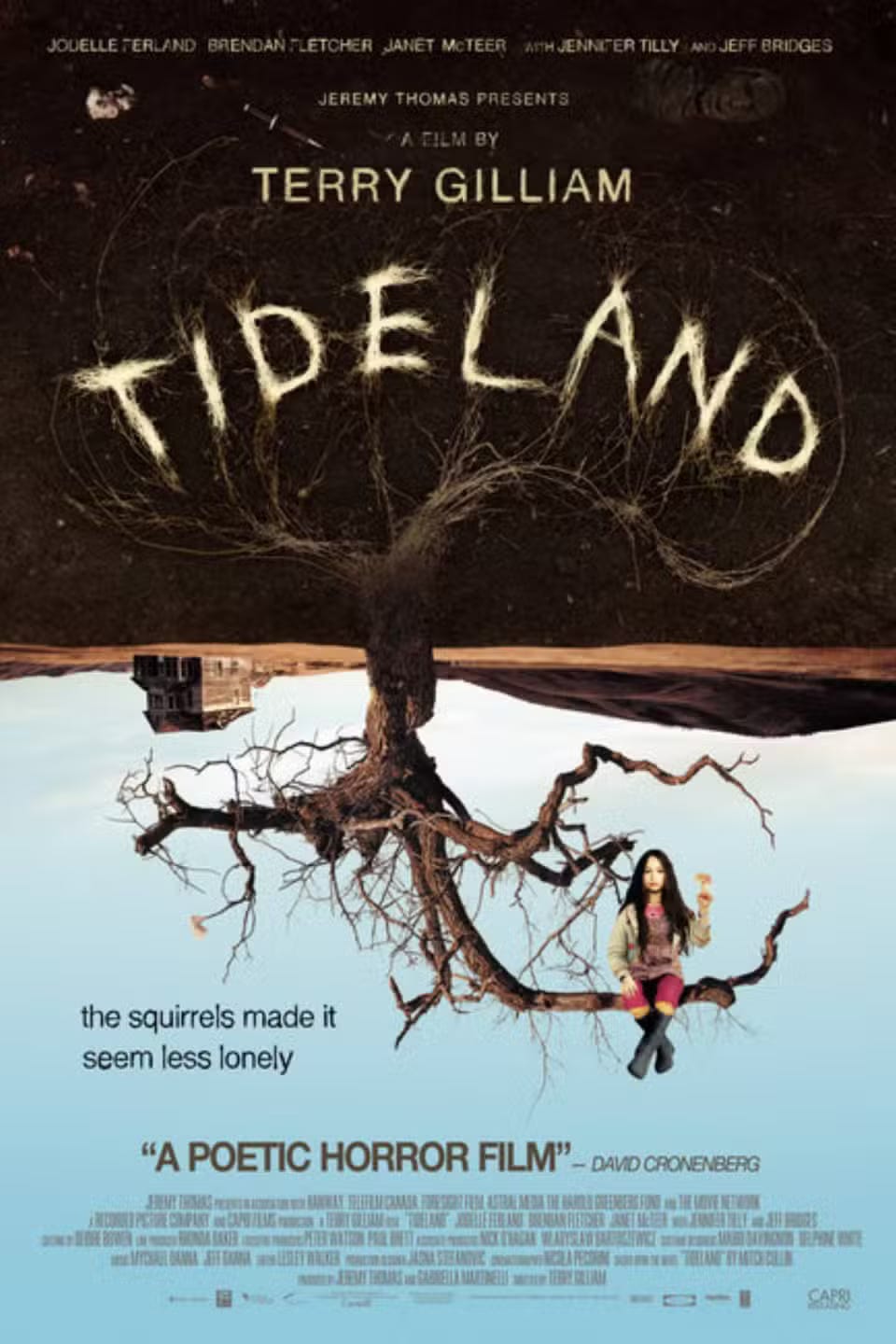
Terry Gilliam’s Tideland (2005) is the most honest movie about childhood and imagination.
Tideland starts with an introduction by Gilliam himself describing his attachment and motivation to tell the story, ending with him announcing “I’m 64 years old, I think I’ve finally found the child within me. It turned out to be … a little girl.”
Though apparently earnest on its face, the strangely lit black and white frame with the sides of his face keyed too high and a looming shadow over his right shoulder (frame left), as well as Gilliam’s reputation for surrealist humor, meant that this introduction did the movie no favors in getting people into the vibe of the piece, as I distinctly recall the strained and uncomfortable laughter in the theatre to this line when I first saw it. I had hoped that it was just a special introduction for the screening I went to, but it turned out to be burnt right into the DVD edition I later bought. It’s an unfortunate choice regarding the experience of the film, but it’s not really incorrect in terms of Gilliam’s self-expression or spark of recognition in the book he adapted.
Tideland follows Jeliza-Rose, the imaginative and precocious child of a couple of heroin addicts. When her father, played by Jeff Bridges1, discovers her mother has died of an overdose, he runs himself and Jeliza-Rose off to a remote family farm in Texas for fear of being arrested. There, he ODs himself, and Jeliza-Rose is left to fend for herself with a strange witchy taxidermist neighbor Dell and her severely cognitively stunted brother Dickens.
This is not a pleasant movie, which is why critics hated it, viewers mostly stayed away, Gilliam fans were mixed, and my friends didn’t appreciate my hot take. One friend I told my take to literally stopped what he was doing, turned to me and said, “C’mon Dane. No. Don’t even go there.”
But I stand by it. Tideland is about childhood imagination and wonder in a way that is uncomfortable and disturbing, but is honest.
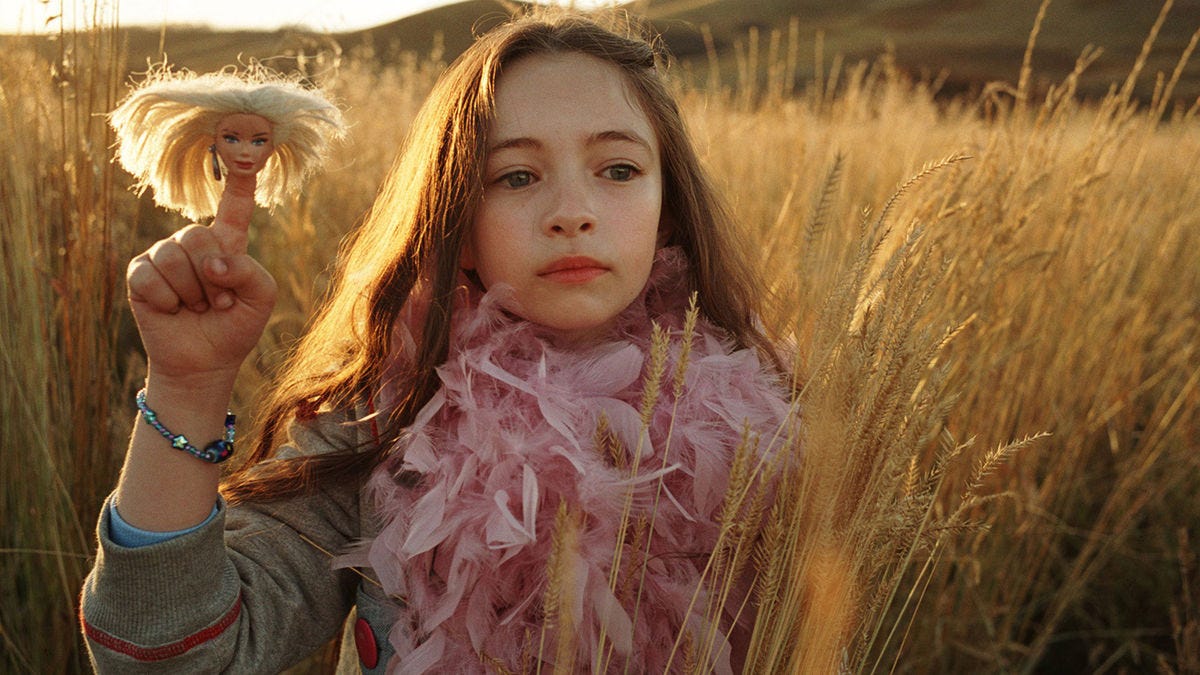
One of the key terms in Gilliam’s introduction, and a rule he seems to have stuck to closely, is “innocence”, and what that means from the perspective of a person who does not really understand the context of the world around her.
Tideland is shot predominantly in horizon-bending wide angle lens, doing the double duty of making the world loom large around Jeliza-Rose while circling the focus in on her. As a ‘child-eye’s view’ it’s less lower angle and more self-centered and expansive.
Self-centeredness turns out to be a major operand running through the concept of innocence here. Jeliza-Rose is not disturbed by the things that happen around her because she doesn’t know anything else. She helps her parents shoot up because it’s a mere chore they have taught her to do. Not knowing that the things are bad or wrong or dangerous, she mostly using imagination to keep herself occupied while her parents are comatose under heroin, building worlds out of the small bits and pieces she has around her, like her doll’s heads.
When she ends up alone with her father’s corpse, the movie plays with our awareness of her awareness of his death: on the one hand, she’s used to him not moving for long stretches of time, and things like rotten gasses emitting from him aren’t anything different than the flatulence he’d perform around her to make her laugh. On the other hand, as his ‘sleep’ stretches onward she escapes further and further outside and more and more into her imagination as a necessary reaction to avoid facing a hard truth she’s too young to truly understand.
She’s not the only one whose innocence covers up for the audience’s awareness of darkness. In one memorable scene, Dickens and Jeliza-Rose are playing, and Dickens, laughing, tells Jeliza-Rose about how he used to like kissing his grandmother because “her mouth would dance in mine like a goldfish.” Squealing in delight, Jeliza-Rose starts darting her tongue around in imitation of the goldfish, Dickens picks up the game, and the two go about giggling and wagging their tongues in perfect childhood mimicry of what we know to be an incestual molestation of a mentally retarded child. Jeliza-Rose and Dickens do not, is the dissonance the movie confronts us with, which is a hard thing to ask of an audience.
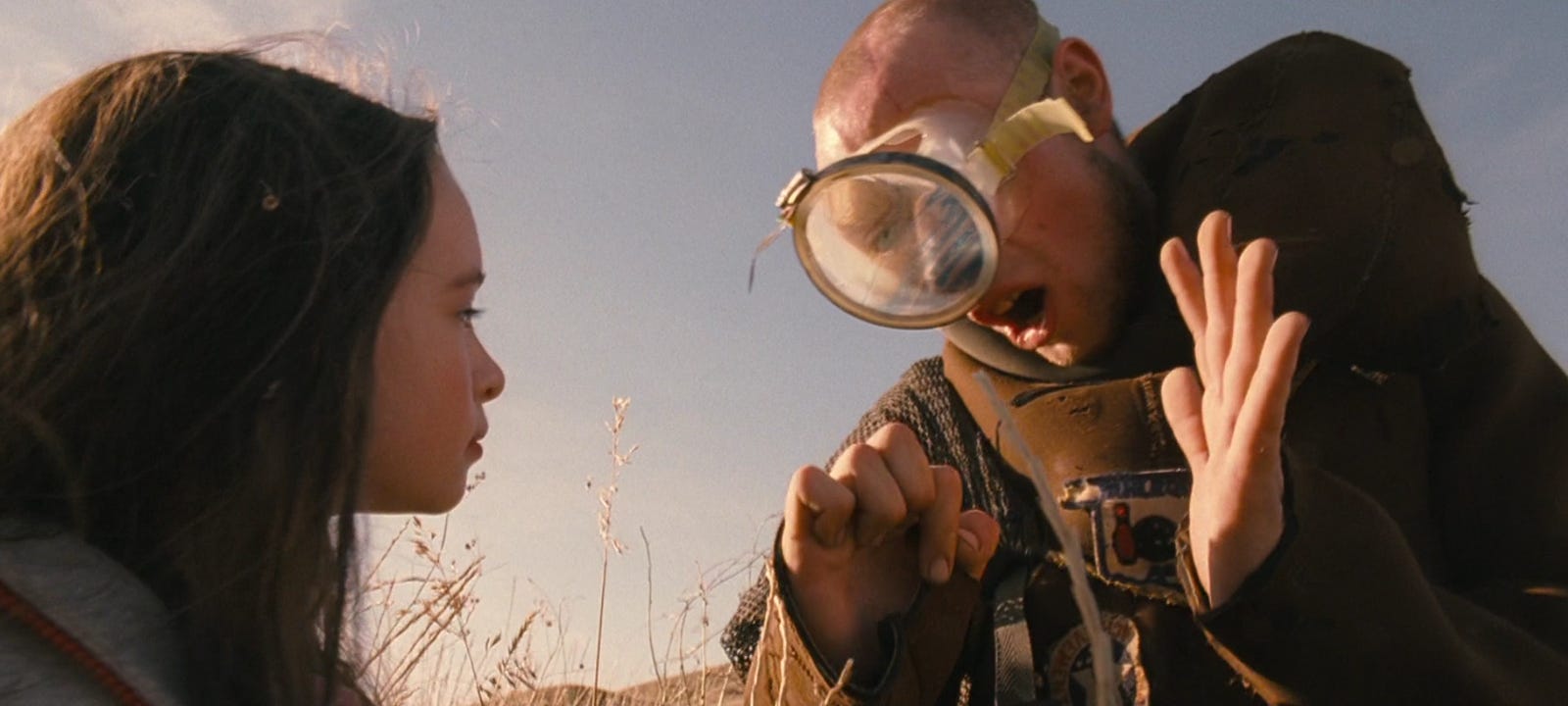
But, that’s the thing about childhood. You don’t really understand the things that are bad or wrong or weird until adults tell you. There are certain things you don’t like because they hurt or scare you or you’re not socialized to understand them, that are often less real than the actual dangers you’re facing. Children are afraid of the shadows under their own bed but that doesn’t make them know that a grandmother’s kisses should not under any circumstances feel like a dancing goldfish. How would they?
Innocence is self-centered. We the audience watch Tideland expecting Jeliza-Rose to realize what’s wrong, grow up, or be saved, but the climax is interesting because it doesn’t come out of Jeliza-Rose maturing, it comes out of her being frustrated and angry with Dell and Dickens not giving her what she wants. Once she realizes her dad won’t wake up and Dell won’t leave her alone, Jeliza-Rose stomps off and intermingles with the injured passengers of a train accident2 so that she can run away.
This ending drove people crazy, and was a key complaints in many reviews and discussion of the film. I’d then ask, “But really, remember how many playdates at that age ended with a kid getting angry and just taking all of his toys home with him?”
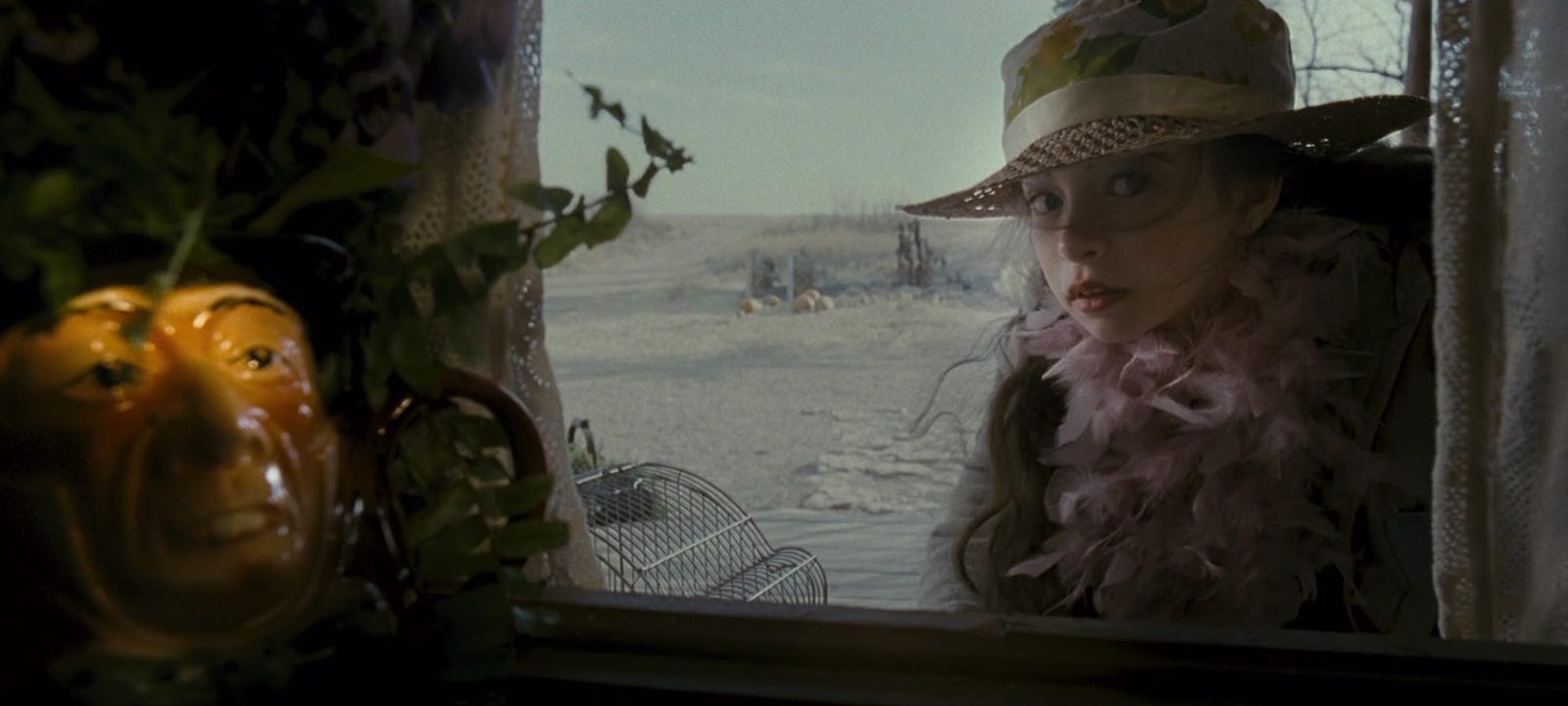
Let’s put this discussion into context with what I think people expected out of a movie like this.
Tideland’s story belongs to a certain subgenre of which I have no name, the sort of children’s fantasy adventure coming-of-age story where the theme is “The Power of Imagination™” as the youth escapes from either a boring or bad personal “Real World” into a parallel universe where they get to evade dragons and big heavies —who often reflect the child’s antagonists of the real world — before defeating them and then usually returning to their former life bringing some of their magic powers back or deciding that the parallel magic world is far better and quitting quotidian reality for good. The characters are almost always shyboys and quirky girls. Think things like Labyrinth, The Neverending Story, and literally everything Neil Gaiman has ever written.
These stories have a built-in metanarrative: fantasies about how fantasy saves us, and in fact are preferable really to the problems reality cause. They rely on presuming certain values about what youth, imagination, and innocence mean, mostly positive. These qualities underwrite the character’s access to magic and the ability to sometimes even literally imagine themselves out of physical danger.
In Tideland, however, the real world, and its dangers, never really go away. Youth, imagination, and innocence can all have an obverse side that is also just selfishness, escapism, and ignorance. The power of imagination is strong enough that the kid doesn’t grok the abjection of her very unhealthy surroundings.
In commercials we like to show children drawing stars and singing beeps and boops to themselves to play at being astronauts. We don’t tend to show the times children tell other children that astronauts are stupid or stars are boring or stop making those weird noises with your mouth. Parents tend to share memes about their kids saying something precious like, “My Christmas wish is for world peace!”, a thing I actually wrote on my list for Santa when I was 8. They don’t tend to share the times their kid punches another kid in the back of the head for cutting in line, which I also did when I was 8. Media doesn’t really like looking at the dark side of childhood, and where bullies or misbehavior is shown, it’s never in the realm of imagination, creativity, or play.3
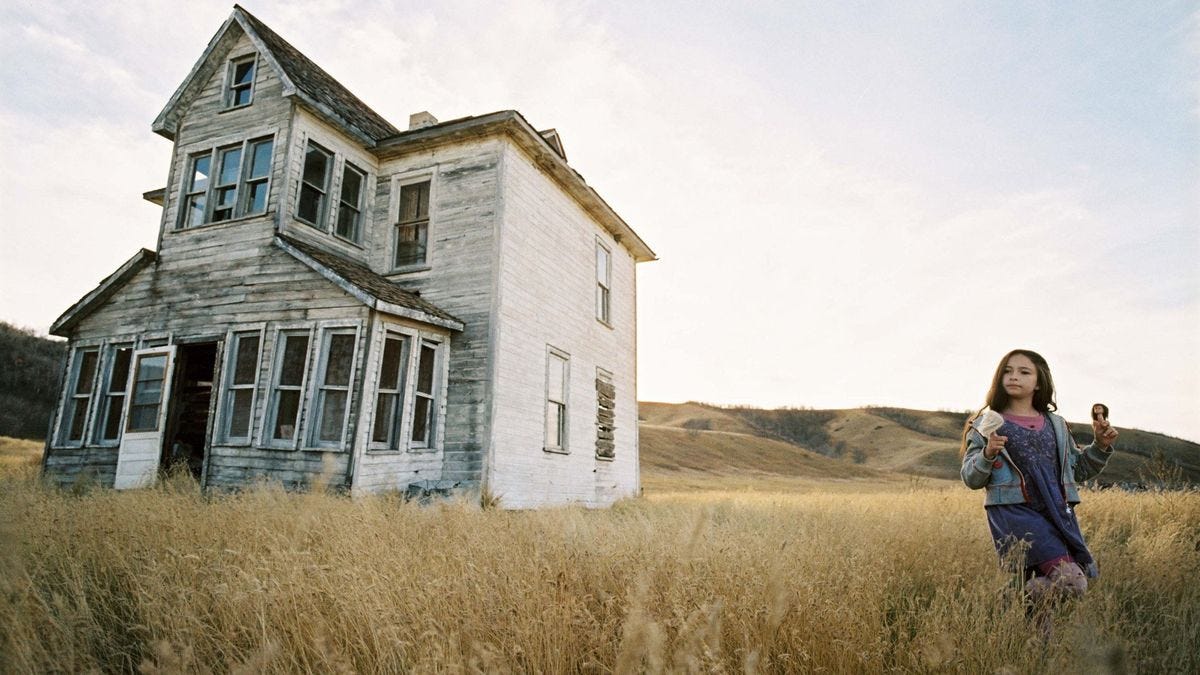
Another way of putting this is that “Tideland” is the anti-Neverland. In both locations, the characters never grow up: Dell is a taxidermist who freezes life from fully rotting into death (and is stuck in sentimental nostalgia for Jeliza-Rose’s father), Dickens is an adult with a child’s mind, and Jeliza-Rose is the Wendy that leaves to go grow up somewhere else. They are childish, child-like, and a child respectively. But here, eternal childhood is the very thing that makes the place disturbing rather than enchanting — a Neverland you don’t, actually, want to go visit.
Certainly Gilliam could have tried making a statement like this without pumping the volume to 11, but I don’t think trying to show the dark side of childhood wonder would have been as parsable and understood if it were subtle.
Also, Tideland comports to Gilliams twisted, surrealist sense of humor. I think another fan expectation was that Tideland would be something more like Time Bandits, a charming children’s adventure where a boy runs off with little people to steal treasures from various realms and historic epics. But Gilliam can swing ‘imagination’ and ‘whimsy’ both ways. In The Fisher King, imagination frees; in Brazil, it traps. Tideland is to Time Bandits what Brazil is to The Fisher King.
I’m not saying it’s a great movie to watch about childhood. I’m saying that it’s honest, and that I appreciate it. It sparked recognition in me in how it showed children playing, the way they started with simple ideas and worked themselves up until their inner worlds overtook them, much like how I mentioned Bridge to Terabithia gave me that same recognition in a previous FilmStack challenge.
The difference is that Tideland acknowledges something important, and it’s those moments when you think back to things that happened in childhood, and your stomach drops, and you realize how problematic that memory actually was. It could be something you caused, like when I almost burned the house down by leaving a lit candle on my bed, or a friend you played with who later turned out to have some issues your parents separated you from, or a time you thought you were participating in something fun and whimsical and it turned out to offend or hurt someone.
Tideland tells that all from the child’s-eye view and sets its coda by how Jeliza-Rose interprets and reacts to things. She has no parents, so the parents don’t provide the directions or lessons. Left to their own devices and without the guardrails of adult supervision, then, a child’s view of the world can be very disturbing to adults. Such is the remarkable honesty of Tideland.

For more FilmStack Challenges:
For more film nerdery:
Tip me through Venmo!

Bridges is worth naming specifically as far too many people went into this movie wanting to see The Dude and ended up with doll heads flying like bats inside his ribcage.
That she caused (!)
Special shout-out to Sid from Toy Story for being a wonderful and memorable exception. Many people point out how his toys are actually quite creative and show a kid who really needed some special attention. Sid is, in fact, exactly like a kid I know who grew up at the far end of my neighborhood, who was super creative and imaginative, and whom my parents banned from letting me play with because he was a bully turning me into his toady.
I can’t attach images to post comments so adding images of The Reflecting Skin here. The director (Philip Ridley) characterized it as “a mythical interpretation of childhood” which could’ve easily been Gilliam explaining his work. I was floored. Viggo Mortensen and Lindsay Duncan crushing it. 1990.
I remember seeing this on the shelf at blockbuster when it was new and renting it without really knowing what it was. I remember the film enough to be both pleasantly surprised that you brought it up and also mad that you reminded me of it because it is a movie with some quite upsetting parts. Not a movie I'd watch again, but not because the movie itself is bad... just, uncomfortable.